Scar healing: stages, duration and caring for your scar
How scar healing works: the stages of wound healing, why a scar matures for up to 18 months and how to care for it along the way.

Dr. Mariam Omar, Specialist in plastic and aesthetic surgery
Contents
Scar healing process: tips & care
Do you want to have an inconspicuous scar? Everything about the healing process, scar care and how you can care for your scar.

Basics about your skin
In the course of your life, the surface of your body is exposed to various environmental influences and events. Your skin (epidermis) is always trying to heal injuries in order to restore its protective layer. This protective mantle protects your body from cooling, overheating, infections and fluid loss. The skin is the largest organ of your body in terms of area and covers an area of about 1.6 m² for women and 1.9 m² for men.
How does a scar develop?
After injuring your epidermis, your body immediately begins to heal the wound. The injury can be accidental, like a burn, or deliberate, like an operation. The wound healing process is different. In the case of surgery, the chances of contamination of the wound (and thus complications during treatment) are much lower. In both cases, special attention should be paid to the injured tissue and the healing process should be closely monitored.
However, a permanent, visible scar does not always develop. In the case of an injury to the epithelium (the upper layer of the skin), epithelial wound healing occurs without scars. A sunburn, for example, is called a first-degree burn and heals without scarring.
How long does a sutured wound take to heal?
A normal wound, such as a surgical incision, can take up to 14 days to heal on the body, but on the face it takes about seven days.
Stages of wound healing
Wound healing is the repair mechanism of the skin after an injury. It takes place in different stages:
1. Exudation phase (day 0 to 4):
If there are no complications, wound healing begins with the exudation phase. The wound closes, cleans itself and repairs itself through various complex immune-specific processes.
2nd granulation phase (day 4):
The granulation phase then begins. Granulation tissue is built up and finally covered with the horn-forming cells, the keratinocytes. Primary wound healing is completed.
3rd epithelialisation phase (day 4 to 21):
Wound healing is complete (the skin is fully epithelialised) and has a scar as a result.
After wound healing, scar healing takes place (up to 18 months).
The scar shows differences from intact skin, which is why it is always noticeable in the skin colour, i.e. the colouring of the skin. It has neither hair nor sweat glands and has no pigment cells.
The collagen fibres are not yet evenly arranged, but have yet to align themselves in the course of scar healing. Elastin fibres are also newly formed. This process can take up to 18 months, depending on the injury and body region.
Healthy collegial tissue is elastic and stable because the fibres are in an ordered network. The arrangement of collagen fibres in scar tissue is disordered and thus has less elasticity. In addition, new blood vessels form in the scar area, which leads to scar redness.
Scar healing in the first months
The scars may be red and raised in the early stages. It is not uncommon for them to be very sensitive to pain or to be accompanied by itching.
Different types of scars & different scar patterns
You have probably noticed that scars always look and feel different from other scars. Of course, all of us would like to have a small fading line in the skin colour that is not raised and is at the level of healthy skin. However, this is not always the case. It always depends on where the scar is located on the body. The part of the body and the age at which it occurred also have an influence on the appearance of the scar.
Scars on large joints
A scar can also develop in a place that is exposed to a lot of mechanical stress, such as the knee. There it is exposed to forces such as shear and tensile forces and can therefore lead to movement restrictions if it runs over a joint and becomes very rigid.
Scars in children
Large scars tend to be unfavourable in children because growth stretches the scar. It is not uncommon for the scar to appear red and conspicuous. The child’s growth does not allow the scar to rest. The collagen fibres must constantly adapt and remodel themselves to the new situation.
Scars in adults
In adults, the scarring process is usually completed between 6 and 18 months. Under the skin, however, the scarring process can last up to three years. This depends on the degree of injury. Facial scars often heal best and are the most inconspicuous.
Caesarean section scars
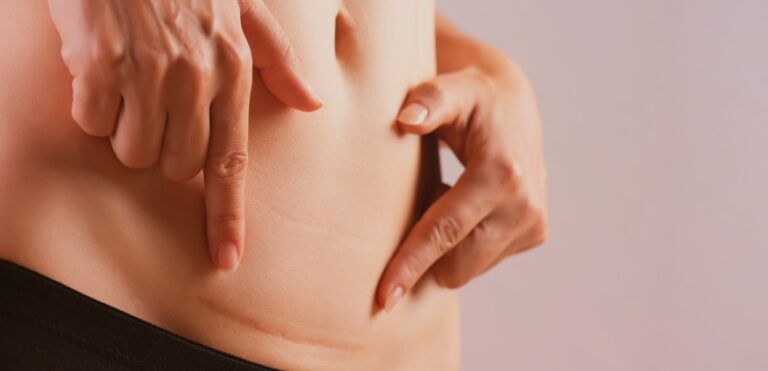
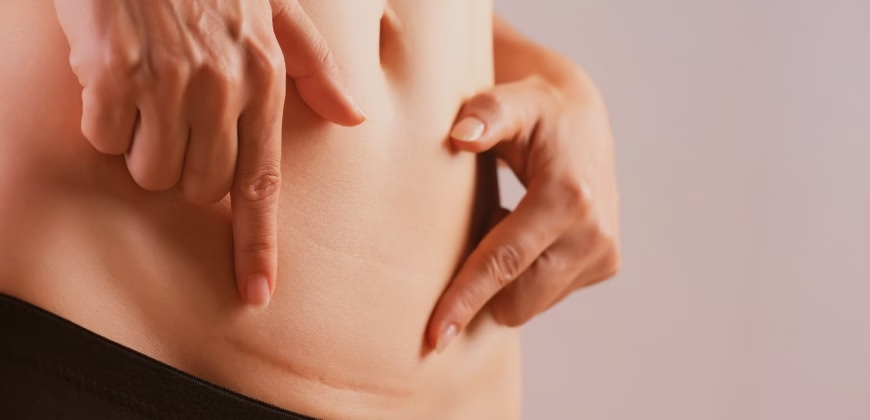
If a scar is caused by a smooth surgical incision, such as a caesarean section, it is an ideal condition for a blanched scar to heal. However, a caesarean scar can become very firm or retract.
Scars from accidents & injuries
If the scar is caused by injury, it often becomes unstable in its course and can come under tension. If it is also accompanied by tissue loss, it may be below the level of the skin.
Atrophic, hypertrophic & keloid scars
Atrophic scarring often occurs in inflammatory processes where the body fails to produce enough granulation and connective tissue to compensate for the loss of substance. This is seen, for example, in acne scars.
Hypertrophic scarring is excessive scarring. It lies above the skin level and is accompanied by redness. Too much collagen is reactively produced by the fibroblasts. When these stop their activity, they are broken down again in their inactive form. However, it may fade again after six months at the earliest or later in the course of the scar’s development.
The cause of the keloid scar has not been clearly explained to date. It is probably genetic and tends to occur in dark-skinned people and in people of Asian descent. It also occurs in red-haired people and pale skin types. It is bulging, raised and not confined to the area of injury. It can also become confluent and cause pain. There are different therapeutic approaches, such as cortisone treatment, radiation or bleomycin therapy. Cutting out the scar often leads to the opposite and progressive course.
Tips for scar care after surgery
Tip 1: Care for the scar once the wound has closed
Start caring for the scar once the wound is fully closed – usually from around day 14 and after checking with your practice. There are scar gels, creams and silicone sheets, often with silicone or onion extract. What they have in common is that they protect the skin from drying out and keep it soft and supple. The feeling of tightness then often eases.
Tip 2: Pay attention to the ingredients in scar care products
When choosing a care cream for scars, look for moisturising and lipid-replenishing ingredients and make sure your skin tolerates it well. Besides silicone products, there are also silicone-free creams that are absorbed into the skin. Our Scar Rescue Cream is such a silicone-free care product, with collagen, panthenol, ceramide NP, shea butter and ginger extract, among other ingredients.
Tip 3: Apply a scar massage
Whether it is a caesarean section scar or a burn scar: a gentle daily massage keeps the tissue supple. It is usually recommended twice a day once the wound is fully closed – ask your practice when you can start.
Tip 4: Compression for burns
Another therapy is external pressure. Therefore, compression girdles are always prescribed for burn scars for at least 6 weeks and not infrequently up to 12 weeks. Above all, the scar should not dry out, which is why a silicone plaster is always advised in addition to the use of a scar cream. It is mainly used at night.
Tip 5: Protect your scar from the sun
The scar is very vulnerable, especially in its early stages, and should therefore not be exposed to intense sunlight for at least 6 to 8 weeks.
Tip 6: Watch your diet
You should eat a diet rich in vitamins and proteins during the healing process. Furthermore, the body has an increased need for antioxidants, especially in the wound healing stage. Whether food supplements make sense for you is best discussed with your doctor.
Tip 7: Be patient
Apply your local scar care twice a day for the first few months. You can combine this with your scar massage. You need patience when it comes to scar healing. During the first few weeks, the scar will develop, which you can recognise by the changing skin colour and elevation. Over the course of the following months, the scar will become more and more inconspicuous and will ideally fade over time.
This article is for information only and does not replace medical advice. If you have questions about your skin or scar, talk to your doctor.
About the author
Dr. Mariam Omar is a specialist in plastic and aesthetic surgery and developed the BEAUTÉ OMAR skincare range. More about Dr. Omar