Scar care after breast surgery: when to apply cream and massage?
When can you apply cream to the scars after a breast augmentation, lift or reduction, when can you massage them – and which bra is right now? Dr. Mariam Omar, specialist in plastic and aesthetic surgery, explains week by week how to care for the scars and when to contact your practice.

Dr. Mariam Omar, Specialist in plastic and aesthetic surgery
Contents
Whether breast augmentation, breast lift, breast reduction or reconstruction after breast cancer: every breast operation leaves scars. Breast augmentation and reduction are among the most common procedures in plastic surgery – the roughly 100 specialists surveyed by the VDÄPC alone reported a total of 4,653 breast augmentations and 4,071 breast reductions for 2024. The scars are usually well hidden, for example in the fold under the breast or at the edge of the areola. Still, they do not have it easy: the weight of the breast, every movement and the bra pull and press on them. If you care for them correctly at the right time, you keep the skin supple and support it well through the months in which it matures.

The key points in brief
- Week 1 to 3: The wound is healing. Leave the surgical tape strips on for as long as the clinic says – creams, oils and ointments do not belong on the wound yet.
- From about week 3: Once the wound is fully closed, you can apply cream to the scars once or twice a day after checking with your practice.
- From about week 3: Gentle scar massage, also after consultation.
- Six weeks of rest for the scars: Wear a support or compression bra as prescribed, no jogging or ball sports, no heavy lifting or carrying, do not raise your arms above your head. Only wear an underwire bra once you have been given the go-ahead.
- Don’t cool it: The scar needs good blood circulation.
- Protect it from the sun: No direct sun and no sunbeds for at least three months; in the first year, clothing or SPF 50.
- Patience: Scars after breast surgery mature over 12 to 18 months.
- Warning signs such as a breast that swells severely, increasing redness, weeping or fever need medical attention immediately.
Where the scars lie after breast surgery
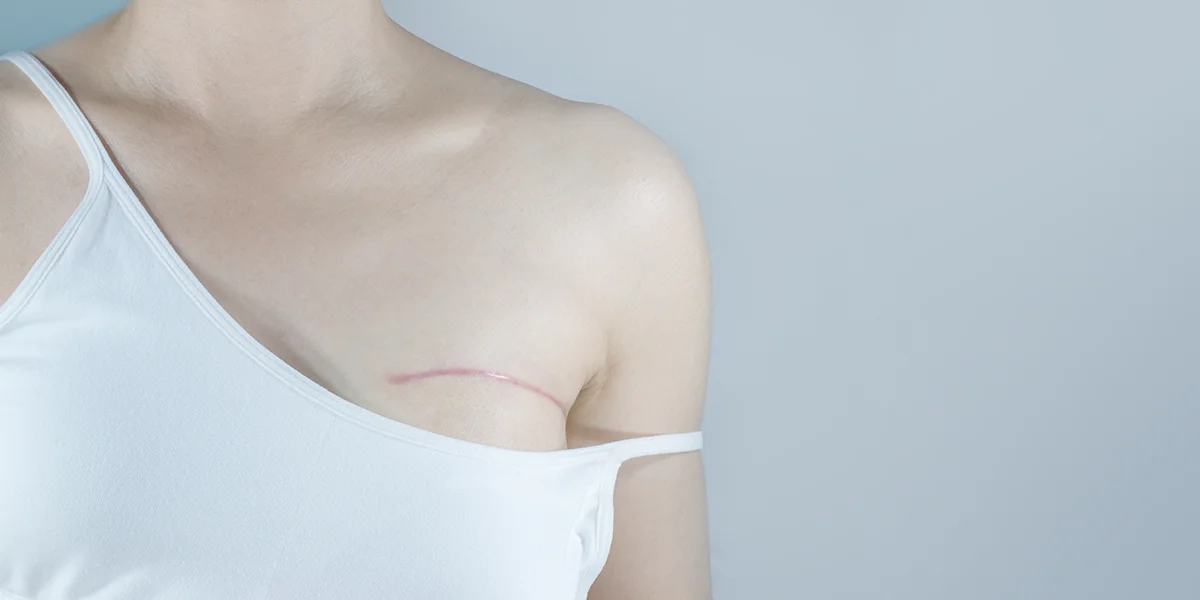
Where your scars are depends on the procedure and on the technique your surgeon has chosen. This matters for care: scars in the fold under the breast are pressed on by the bra, scars at the areola lie on thin, sensitive skin, and where several incisions meet, the skin needs particular rest.
| Scar | What to watch out for |
|---|---|
| in the fold under the breast mainly after breast augmentation | Lies exactly where the underwire of the bra will sit later. |
| at the edge of the areola after breast augmentation or a small lift | The skin here is thin and sensitive; the scar may stretch a little over time. |
| around the areola and vertically downwards (“lollipop”) after a lift or reduction | Is under tension from the weight of the breast. |
| additionally across the fold under the breast (anchor or T incision) after a larger reduction or lift | Where the incisions meet, the wound is most likely to heal poorly – be particularly gentle here. |
| in the armpit with some breast augmentations | Friction from movement and clothing; no deodorant on the fresh wound. |
After breast cancer surgery, the scars lie on the breast, in the armpit or where tissue was taken for reconstruction, depending on the procedure. You can read what else applies further below.
How can you tell that the wound has closed?
Only start caring for the scars once the wound is fully closed. You can recognise this by these signs:
- The wound edges lie smoothly against each other, with no gaps anywhere – including where the incisions meet.
- Nothing is weeping, bleeding or oozing pus any more.
- There are no scabs left; all crusts have come off.
- The surgical tape strips are off, and the stitches have been removed.
If healing is uncomplicated, this is usually the case after two to three weeks. Self-dissolving stitches can take up to three months to disappear completely. Sometimes a bit of thread works its way to the surface in the meantime and leaves a small open spot. Cover it with a plaster until it has healed, and have it checked if you are unsure. Your practice will assess at your follow-up whether your wound has closed – their advice is what counts.
When can you apply cream to the scar after breast surgery?
The right timing is crucial. This overview shows you what makes sense in which phase. Always follow your clinic’s instructions – they know your procedure.
Week 1 to 3: the wound is healing
In the first weeks, the skin closes. Scar creams, oils or ointments do not belong on the wound during this time. The narrow surgical tape strips usually stay on the skin for about three weeks and relieve the wound edges. You may shower as soon as the clinic allows it; wait at least four weeks with a full bath, until the wounds are fully closed.
Take it easy: no heavy lifting or carrying, do not raise your arms above your head and avoid anything that drives up your blood pressure. Walking is usually allowed shortly after you are discharged and does you good. Wear the support or compression bra as prescribed by the clinic – often six weeks day and night.
If you smoke, now is a good time to stop: smoking impairs blood circulation and increases the risk of the wound healing poorly – especially where the incisions meet.
From about week 3: apply cream
Once the wound has closed, the actual scar care begins. Apply a thin layer of cream to the scars once or twice a day, ideally in the morning and evening. Include the surrounding skin: after a breast augmentation, it is often stretched and dry. The care provides the skin with moisture, protects it from drying out and can reduce the feeling of tightness.
From about week 3: massage
After consulting your practice, you can now also start a gentle scar massage. You can read how to do it in the next section.
Until week 6: avoid pulling and pressure
In the first six weeks, the scars should not be subjected to strong pulling. Stretching and tension can make them red or raised. Avoid jogging and ball sports, do not lift or carry anything heavy, do not raise your arms above your head, and ask at your follow-up when sport, an underwire bra and lying on your stomach are right for you.
Month 2 to 18: keep at it
Beneath the skin, the tissue reorganises itself: collagen fibres are formed and remodelled, and new blood and lymph vessels develop. At first the scars are often flat; after a few weeks they become firmer and redder and then fade over many months. You can read more in our guide to the scar healing process. Regular care is worthwhile until the scars have matured.
Scar massage after breast surgery: step by step
Massage keeps the tissue mobile and the skin supple. Many women also experience it as a good moment to get to know their changed breast.
- Prepare: Wash your hands, cleanse the scars and pat them dry.
- Apply cream: Put a small amount of scar cream on the scars and the surrounding skin.
- Circle: Massage along the scar in small circles with two fingertips, using gentle pressure. For the scar in the fold under the breast, lift the breast slightly with your other hand.
- Duration: One to two minutes per scar, once or twice a day.
- Increase slowly: As the scar becomes less sensitive, you can gradually increase the pressure and carefully move the skin against the underlying tissue. Stay gentle for longer where the incisions meet.
The massage should not hurt. If the scar hurts a lot, stop and ask your practice. Important: scar massage is not the same as implant massage, which some surgeons recommend after a breast augmentation. Your practice will tell you whether and how you should massage the breast yourself.
Which bra is right after breast surgery?
The bra keeps the breast in shape and relieves the scars – but it can also irritate them. Here is what matters:
- The first weeks: Wear the support or compression bra from the clinic for as long as prescribed, often six weeks day and night. You can usually take it off to shower.
- Nothing may press on the scar: If a seam or an edge rubs right on a scar, mention it at your follow-up.
- Underwire bra only after the go-ahead: The underwire lies exactly on the scar in the fold under the breast. Many clinics allow it after about six weeks. Because the skin on the breast is often still numb then, you will not notice pressure points straight away – take a quick look after taking it off.
- For sport: a well-fitting sports bra as soon as sport is allowed again.
Can I cool the scar after breast surgery?
In the first days after the operation, some clinics use cooling against swelling. If your clinic has recommended this, follow its instructions – cool packs should never be placed directly on the skin.
You should not cool the scar itself, advises Dr. Mariam Omar: beneath the skin, the tissue keeps reorganising itself for months and depends on good blood circulation. Cold constricts the vessels, and the tissue is supplied with fewer nutrients.
Your morning and evening care routine
A fixed routine helps you stick with it. It only takes two to three minutes:
- Cleanse: Clean the scars with water or a mild cleanser and pat them dry – don’t rub. Dry the fold under the breast well too.
- Care: Apply a thin layer of scar cream and let it absorb.
- Massage (from about week 3, after consultation): one to two minutes in small circles.
- Protect: A bra that doesn’t rub on the scars. Outdoors, clothing or SPF 50 – especially in a bikini or with a low neckline.
Tip: Take a photo of the scars once a month in the same light. That way you can see how they change and have pictures for your follow-up appointments.
Which cream is suitable for scars after breast surgery?
For closed scars, there are creams, gels, oils and silicone sheets. Regularity matters more than the form: the care should provide the skin with moisture, protect it from drying out and keep it supple.
- Silicone gels and sheets form a thin film on the scar that retains moisture. They are well studied, especially for raised scars, and many clinics recommend them after breast surgery.
- Silicone-free scar creams are absorbed into the skin and are easy to massage in. They care for the skin with moisturising ingredients and lipids.
- Plant oils such as almond or calendula oil make dry skin supple and are suitable for massage.
With the Scar Rescue Cream, Dr. Mariam Omar has developed a silicone-free scar cream – for everyone who prefers a cream to a gel or sheet. Its base is a DMS structure (Derma Membrane Structure) that is similar in structure to the natural skin barrier. Collagen, panthenol, niacinamide, ectoin and ceramides provide moisture and support the skin barrier, while shea butter, hemp seed oil and sunflower oil care for dry scar tissue.
Whatever you choose: only apply care products to fully closed skin. If a scar becomes raised despite care, talk to your practice early – silicone is then often the first choice.
Scar care after breast cancer surgery
After an operation for breast cancer, some rules of their own apply, especially if you are having or have had radiotherapy. Irradiated skin reacts more sensitively, for example to fragrances, alcohol or deodorant. The German Cancer Information Service advises always asking your treatment team how the skin in the radiation area may be cared for.
- Agree on when to start scar care with your treatment team. During radiotherapy, only apply what is recommended there.
- The Scar Rescue Cream contains a subtle fragrance. Ask beforehand whether it is suitable for your skin after radiotherapy.
- If lymph nodes were removed from the armpit, the team often has its own advice on movement and care of the arm. Also ask whether you may massage the scar in the armpit.
- Otherwise, the basic rules from this guide apply: only start care once the skin has closed, massage gently and protect from the sun.
What is normal – and when should you see your practice?
Typical symptoms in the first months
- swelling and a feeling of tightness in the first weeks
- a reddened, raised and firm scar in the first months
- numbness or changed sensitivity of the breast and nipple
- itching and pulling at the scars
- a bit of thread that works its way to the surface after a few weeks
Warning signs
Contact your practice or the clinic immediately if you notice any of these signs:
- One breast suddenly swells severely, becomes hard or hurts more and more.
- The wound bleeds again, weeps, oozes pus or smells unpleasant.
- The redness spreads, and the skin is warm.
- The wound edges are separating, often first where the incisions meet.
- The nipple or the skin next to it turns dark, bluish or black.
- You have a fever or feel ill.
In Germany, you can reach the out-of-hours medical service on 116 117 outside surgery hours; in an emergency, call 112. Many clinics also give you their own emergency number for the time after the operation – keep it to hand.
What helps with raised or wide scars after breast surgery?
What a scar looks like in the end depends not only on the care, but also on your disposition and the location: the skin on the upper body is more prone to thickened (hypertrophic) scars and keloids than elsewhere, and where a scar is under tension, it widens more easily. If a scar becomes clearly raised in the first months, have it checked early – it can then usually still be counteracted well. Whether a scar will stay that way can only be judged after 12, preferably 18 months.
| Appearance of the scar | Possible treatment | Where |
|---|---|---|
| red, raised | silicone gel or sheets, treatment with cortisone as a cream or injection | the practice that operated, or a dermatology practice |
| wide, stretched | scar revision once the scar has matured | plastic surgery practice |
| darkly discoloured | consistent sun protection, laser treatment if necessary | dermatology practice |
You can continue to apply cream to and massage an older scar too – this keeps the skin supple.
Frequently asked questions about scars after breast surgery
How long does it take for the scars to heal after breast surgery?
If healing is uncomplicated, the skin closes after about two to three weeks. The scars have matured after 12 to 18 months – only then can their final appearance be judged.
Is numbness of the breast or nipple normal?
Yes, this is common. Fine skin nerves are cut or stretched during the operation. Feeling often returns slowly over months; sometimes an area remains permanently less sensitive. Mention it at your follow-up if it worries you.
Why does the scar itch after breast surgery?
Itching is part of healing for many women, and the skin around the scar is often dry too. Applying cream regularly keeps it supple. Try not to scratch – and if the itching comes with redness, warmth or weeping, have the scar checked.
When can I wear an underwire bra again after breast surgery?
Many clinics allow an underwire bra after about six weeks. Until then, wear the support or compression bra prescribed by the clinic. Afterwards, watch out for pressure points on the scar in the fold under the breast – the skin there may still be numb.
When can I take a bath, swim or go to the sauna?
Only once the wounds are fully closed and your practice agrees. For a full bath, this is the case after four weeks at the earliest. When swimming pools and saunas are right for you is best asked at your follow-up.
When can I do sport again after breast surgery?
Walking is usually allowed shortly after you are discharged. Jogging, ball sports, heavy lifting and carrying and movements with your arms above your head come after about six weeks at the earliest, after consulting your practice. Discuss exercises for the chest muscles, such as push-ups, separately – especially if an implant lies under the muscle.
Can the scar be exposed to the sun after breast surgery?
Avoid direct sun and sunbeds for at least three months. In the first year, protect the scars with clothing or SPF 50, because UV radiation can cause permanent discolouration.
Is scar care worthwhile for an older scar?
Yes. Care and massage keep an older scar supple too. How much a scar still changes depends on its age, its location and your skin. For clearly raised or wide scars, a consultation at a specialist practice helps.
Sources
- VDÄPC (Association of German Aesthetic Plastic Surgeons): treatment statistics 2024, survey of around 100 members; reported by Ärztestellen (Deutsches Ärzteblatt), 3 July 2025.
- Agaplesion Diakonieklinikum Hamburg, Department of Plastic, Reconstructive and Aesthetic Surgery: recommendations after breast surgery (May 2024).
- AWMF guideline 013-030 (S2k): Treatment of pathological scars (hypertrophic scars and keloids).
- Primary Care Dermatology Society (UK): Scars – hypertrophic and keloid.
- Cancer Information Service of the German Cancer Research Center, quoted in: aponet.de, “Tips for skin care after radiotherapy”, 17 August 2022.
This article is for information only and does not replace medical advice. If you have questions about your skin or scar, talk to your doctor.
About the author
Dr. Mariam Omar is a specialist in plastic and aesthetic surgery and developed the BEAUTÉ OMAR skincare range. More about Dr. Omar